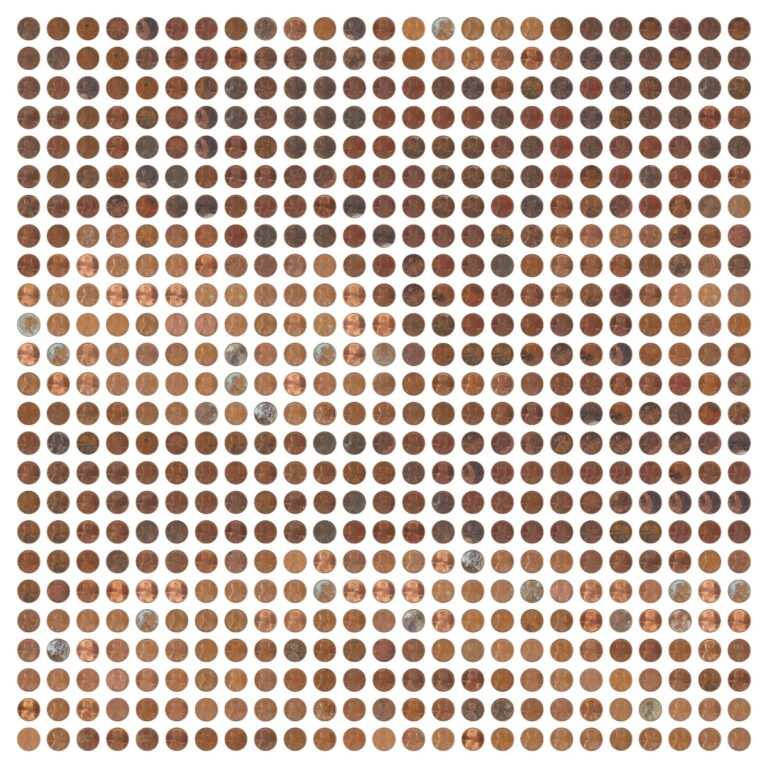
Over one week in late August 2026, I inscribed AdjaCENTS, a series of twenty-one animated works, seven triptychs of three, assembled entirely from cents that no longer exist. Every coin on screen belongs to Rutherford Chang’s CENTS, a project for which he pulled 10,000 one-cent pieces out of circulation. All of them were copper, dated 1910 to 1982, photographed, inscribed as Bitcoin Ordinals, and then melted into a single block of copper. Even the block is there: it closes the collection as a 3D model, inscribed alongside the coins it consumed. The physical pennies are gone. Their portraits remain, each at its own permanent on-chain address.
The series set out to do two things. The first is an homage: to a body of work I keep returning to, and to the quiet finality of its gesture. The second is a technical experiment with recursive inscriptions, inscriptions that load other inscriptions by their on-chain address: could an animation system be built where the tiles already exist on chain, inscribed by someone else, and my works contribute nothing but arrangement? The name compresses the method: AdjaCENTS, adjacent cents, coins that only ever stand next to one another.
From stamps to cents
Tiling has been a part of my practice for years. My earlier series grew out of stamping: I digitized stamp marks, painted squares, and other handmade sources, then wrote Python pipelines that sort thousands of these tiles by tone and reassemble them into moving skies. The material was always mine, made by hand, scanned, and sitting on my own disk.
AdjaCENTS flips that one assumption. The library is Rutherford’s. Each cent is already inscribed at an immutable address, and together they span a narrow, weathered range of copper, from bright mint through deep corrosion. I indexed the collection, measured every coin’s shade, and drew a palette of 484 cents, ordered from darkest to brightest. That palette was inscribed once, as a plain list of his inscription IDs, and all twenty-one works read from it.
The count itself is a small act of numismatics. 484,000 is the mintage of the 1909-S V.D.B., the first-year Lincoln cent struck at the San Francisco Mint with Victor David Brenner’s initials on the reverse, which was withdrawn within days after the public objected to such a prominent signature. It is the key rarity in the entire Lincoln series, and Rutherford’s Cents begin in 1910, the year after its introduction. Settling on 484 felt like the right way to honour the coin his collection starts just short of; that the number is also a palindrome, and 22 squared, did not hurt.
Nothing is stored
The series is built on a 25 × 25 grid, 625 cells animated at 30 frames per second. That grid is the base of the entire series: most pieces adhere to it directly, and the later triptychs derive their merges, pairs, and quarters from it. On chain, a work consists of only two things: a small HTML renderer of 7–16 KB and a compressed frame table, a run of 16-bit indices into the shared palette, one per cell per frame. No image data of mine is inscribed anywhere.
Notably, each artwork exists only while you watch it. Opening a piece fetches the palette, the frame table, and all 484 coins from the chain; the animation is assembled on the spot, in your browser’s memory and cache, and plays from there. Close the tab, and the assembly is gone; nothing of the rendered work is ever written to a file, a server, or the chain. What persists are the instructions, and the cents themselves, waiting at their addresses to be borrowed again.
In a nutshell: one palette, twenty-one frame tables, twenty-one small renderers, and more than 13,000 cells across the series resolving to the same 484 inscriptions that were already there. The artworks are children of the AdjaCENTS series marker under my artist root Ordinal; the palette and frame tables are children of my shared-assets holder. Unsurprisingly, the count is no accident either: twenty-one works, a familiar number in Bitcoin, grouped in threes across seven triptychs, seven being a number I keep returning to.
The day the cent ended
One more date is folded into the series. On November 12th, 2025, the United States Mint held a ceremonial final strike in Philadelphia: the last circulating one-cent coin, ending a run of 232 years that began in 1793, with the final coins carrying an Ω mint mark. The AdjaCENTS series marker is inscribed on the opening sat of a block mined that same evening, sat 1,994,804,687,500,000. The marker rests, in other words, on Bitcoin from the first hours in which the smallest denomination of United States currency was no longer being minted, while the smallest unit of Bitcoin still was.
The Seven AdjaCENTS Triptychs
I. Grid Cents
The opening triptych is the most literal translation of my Python tiling system into the new material: each frame of a sky is reduced to 625 brightness values, and each value is answered by the nearest cent in shade. No further rules. Watching it run for the first time felt like exciting: a pipeline built for stamp marks and painted squares accepting, without complaint, coins I had never touched. Clouds become mass, open sky becomes lighter copper, and the whole surface flickers as the matching shifts from frame to frame.
Copper Clouds One
Preview Ordinal
Download video
Copper Clouds Two
Preview Ordinal
Download video
Copper Clouds Three
Preview Ordinal
Download video
II. Merging Cents
The second triptych borrows its behaviour from soap bubbles. Wherever four neighbouring cents drift close enough in tone, they give way to a single cent at double size, two films touching, then one larger bubble where there were four. The merges are decided at draw time, not stored in the table, so large coins surface where the sky flattens and dissolve again where detail returns. The mechanism is simple arithmetic; the effect, I feel, is closer to surface tension, tone pulling copper together.
Copper Clouds Four
Preview Ordinal
Download video
Copper Clouds Five
Preview Ordinal
Download video
Copper Clouds Six
Preview Ordinal
Download video
III. Turning Cents
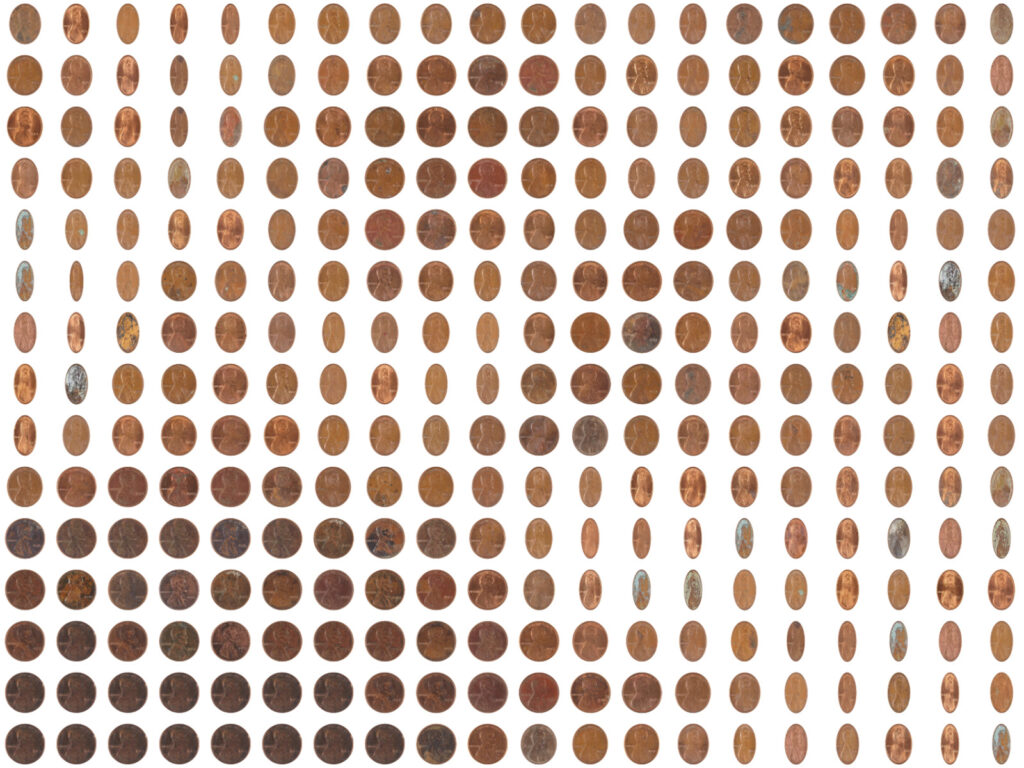
With the third triptych, I wanted the coins to turn. The rule is plain scaling (cents narrow as they brighten, from full width in the dark bands down to 35 percent), but the intended reading is rotation: a coin seen edge-on, catching the light as it spins. The clouds keep their weight while the open sky thins into slender, turning columns. Just as deliberate is the white that opens between them: negative space doing as much of the drawing as the copper, and amplifying the moving sky behind the coins. It is the first triptych in which a cent is no longer shown whole, and the narrowing reads not as loss, but as movement.
Copper Clouds Seven
Preview Ordinal
Download video
Copper Clouds Eight
Preview Ordinal
Download video
Copper Clouds Nine
Preview Ordinal
Download video
IV. Pressed Cents
Anyone who has fed a cent into one of those hand-cranked souvenir machines, at a museum, a lookout, or a zoo, knows the object this triptych is after: the elongated penny, pressed into an oval to commemorate a visit. Here, two neighbouring cells in the bright bands fuse into one cent two units wide and one unit tall, so the luminous passages fill with stretched, reclining coins while the dark clouds stay in small change. Fittingly, each work in this triptych also replays footage from an earlier piece, entered at a different point in its loop: pressed cents commemorating skies the series had already visited.
Copper Clouds Ten
Preview Ordinal
Download video
Copper Clouds Eleven
Preview Ordinal
Download video
Copper Clouds Twelve
Preview Ordinals
Download video
V. Cent Slots
The fifth triptych sinks its coins. The brighter a cent, the deeper it drops below its row, cut off at the cell floor until only a crown remains: the exact impression of a coin disappearing into a slot, caught mid-payment. Bright sky becomes a field of half-swallowed copper. Here, too, the play is with negative space: the emptiness above each sunken crown grows as the sky brightens, and the clouds read through what is missing. Two quieter shifts arrived alongside: Fourteen and Fifteen are the first works built on procedurally generated cloud loops rather than timelapse footage, and from Fourteen onward nearly every cell exchanges its cent for a tonal neighbour every frame; no cent ever repeats beside itself, and all 484 coins stay in circulation.
Copper Clouds Thirteen
Preview Ordinal
Download video
Copper Clouds Fourteen
Preview Ordinal
Download video
Copper Clouds Fifteen
Preview Ordinal
Download video
VI. Half Cents
A nod to the Bauhaus, and the triptych where order gradually takes over. The grid is laid out in pairs of cells, each pair holding a single cent at double size, cut in half by its own tile. One lone square remains at the centre, the one cell whose removal lets a 25 × 25 grid resolve into pairs at all. Darker pairs hold their cent to one edge, and when a pair brightens past its threshold, the cent slides across and the half circle faces the other way. Across the three works, the arrangement moves from found to planned: Sixteen interlocks its pairs irregularly, Seventeen runs an unbroken cross of them through the centre with the rest falling loosely, and Eighteen disciplines the whole field into a checkerboard weave.
Copper Clouds Sixteen
Preview Ordinal
Download video
Copper Clouds Seventeen
Preview Ordinal
Download video
Copper Clouds Eighteen
Preview Ordinal
Download video
VII. Quarter Cents
Each triptych so far cut into the wholeness of the coin a little further: narrowed it, stretched it, sank it, halved it. The final triptych completes the thought: every cell holds just a quarter of a cent, cropped from a coin drawn at twice the size, its tone deciding which corner survives: the darkest cut off at the top and right with the white edge at lower left, the brightest the other way about. Where neighbours agree in tone, their quarters meet and briefly reassemble into arcs, half circles, sometimes an entire coin. Wholeness still occurs, but it is no longer given. It is assembled, cent by cent, and only for a frame or two.
Copper Clouds Nineteen
Preview Ordinal
Download video
Copper Clouds Twenty
Preview Ordinal
Download video
Copper Clouds Twenty-One
Preview Ordinal
Download video
A collection, not a sale
AdjaCENTS is built and held as a collection. Out of respect for Rutherford’s CENTS, a project whose central gesture was taking ten thousand coins out of circulation for good, the works are not for sale. Independently of the chain, each triptych above links to a downloadable render of its full loop. These are there to be shared: if you are a fellow CENTS enthusiast and feel like posting one, please do.
The cents themselves are melted; nothing of them can be spent again. Their portraits, however, keep circulating, on loan to anyone who opens a tab, for exactly as long as the tab stays open. The coins no longer move. The clouds do.