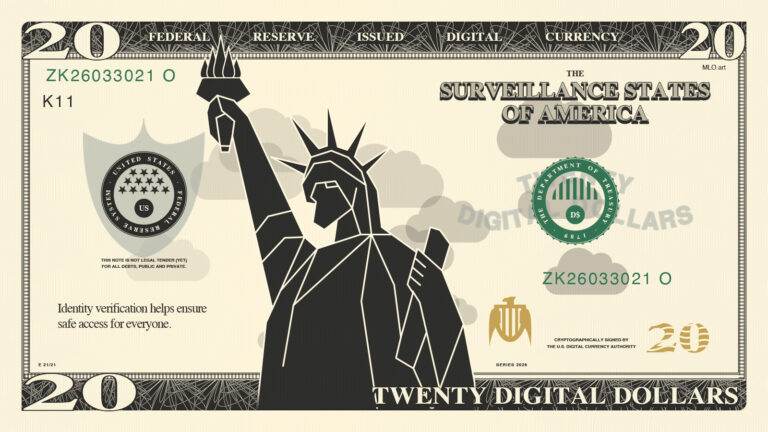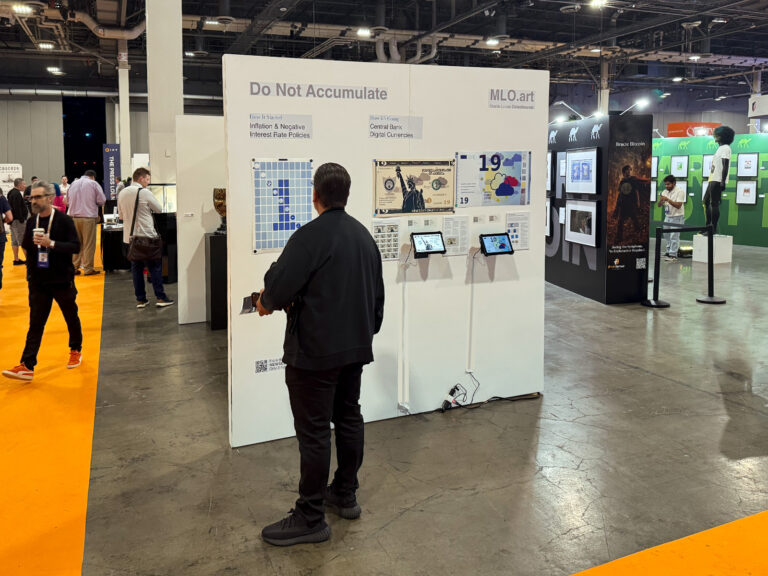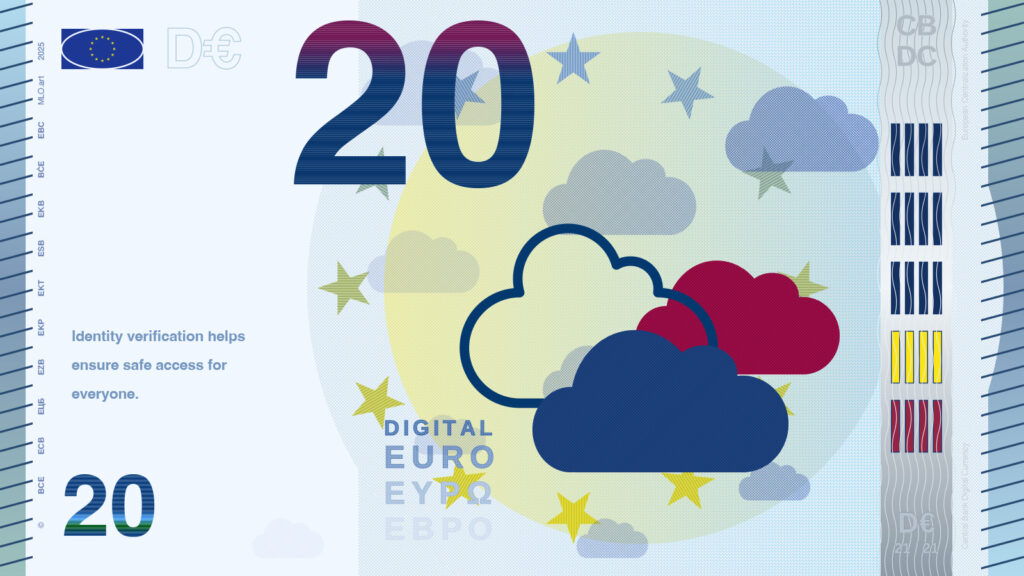
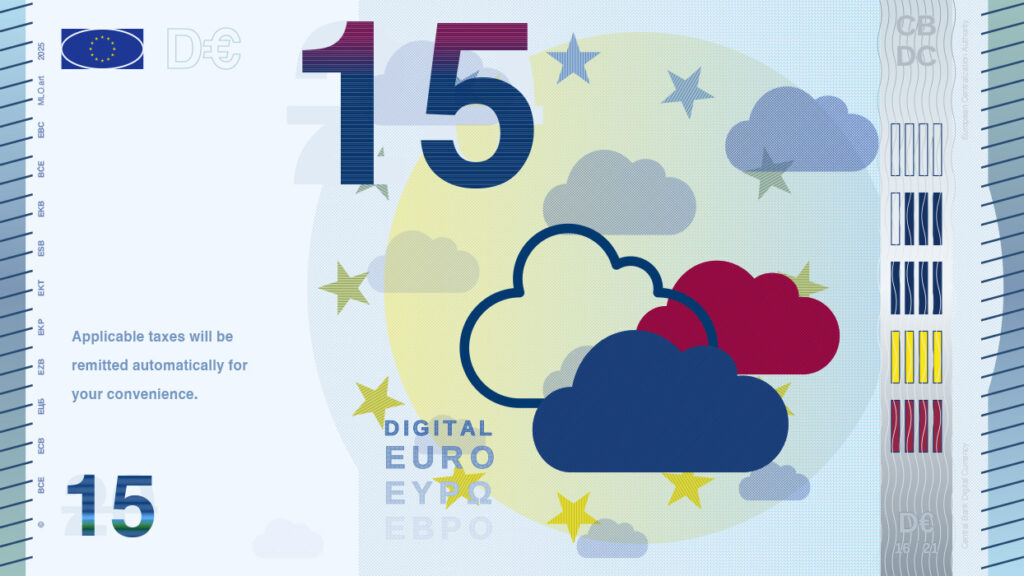
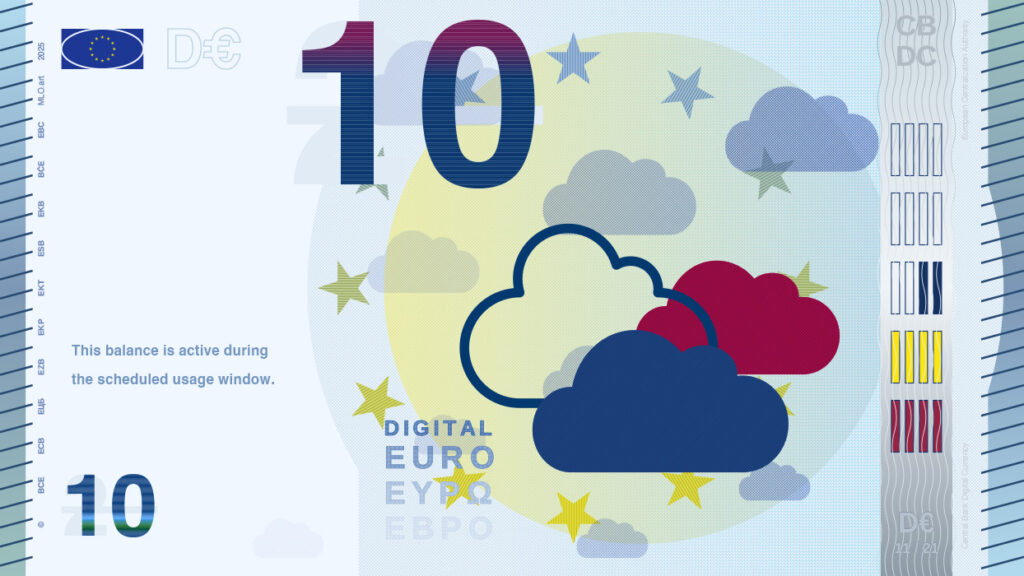
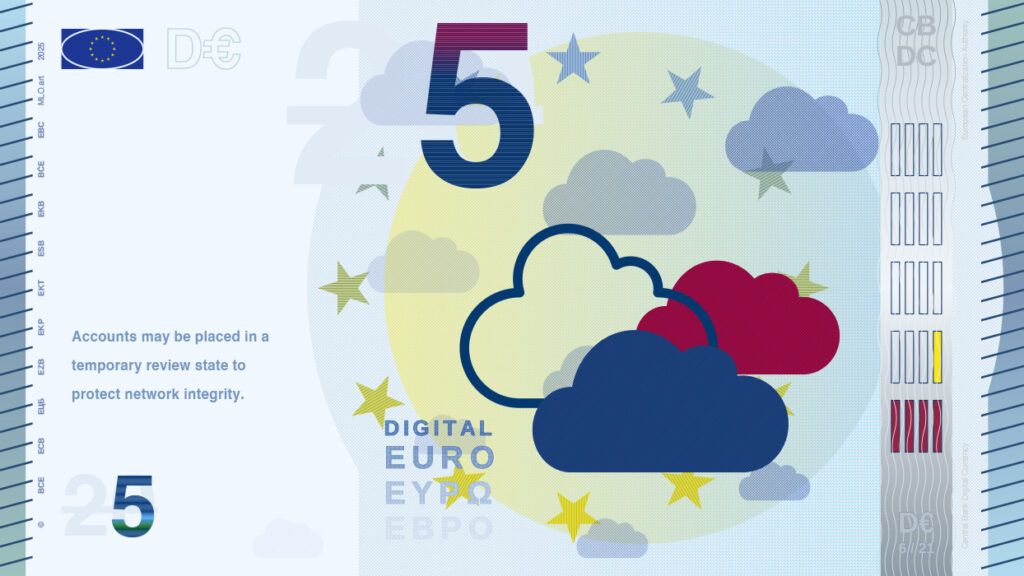
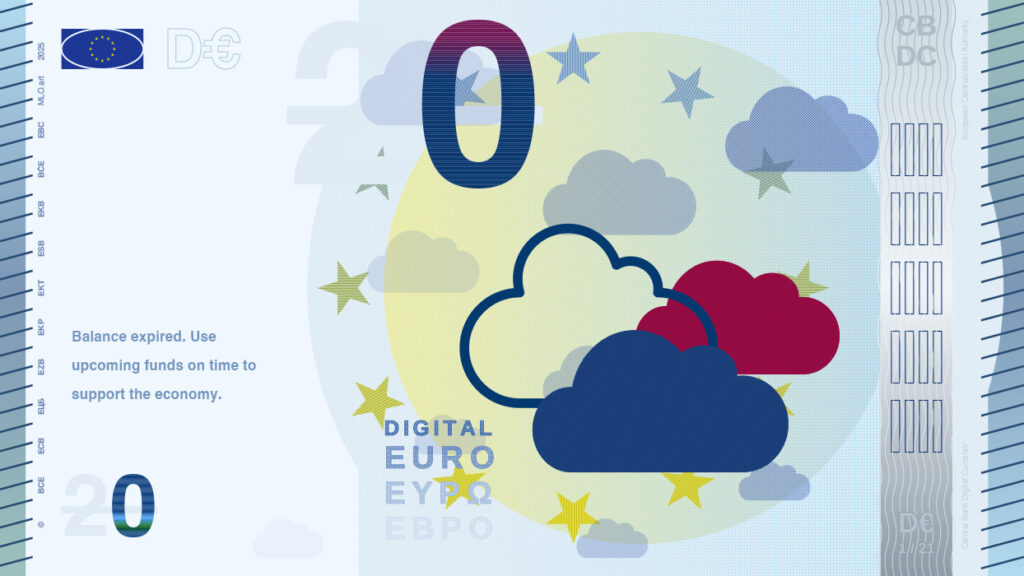
Part of Do Not Accumulate, a net.art series of forty-two imagined Central Bank Digital Currencies inscribed on Bitcoin. The Digital Euro is a single, self-contained HTML banknote rebranded as a currency of the European Centralization Authority. Twenty-one editions exist, each programmed to lose value over a 21-month demurrage cycle.
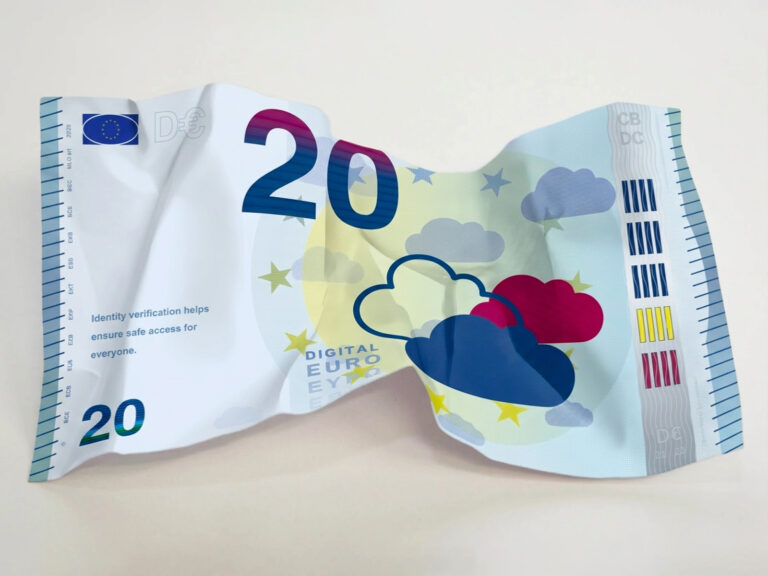
Visual references. Drawn entirely in vector graphics, the bill subverts the design language of the real Euro notes. Where the architectural windows and bridges of every Euro series traditionally open onto empty space, here they open onto a cloud-strewn sky; a cluster of clouds drifts over a yellow sun. Twelve EU stars arrayed around the sun double as the twelve positions of a clock face. The stars turn relentlessly forward, the clouds drift against them, and over the course of the cycle the composition inevitably dissolves into its programmed decay.
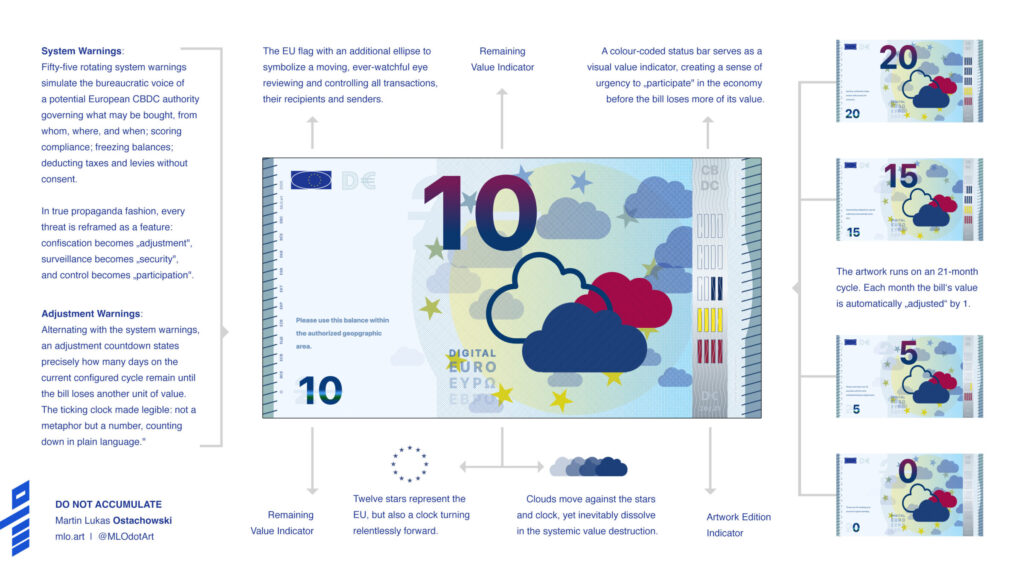
The top-left EU flag carries an additional ellipse: an ever-watchful eye that reviews and documents every transaction, its senders and its recipients, and perhaps, one day, intercepts them. The large central numeral serves as a remaining-value indicator, echoed by a small mirror at the lower left. Along the right margin, a CBDC wordmark presides over a colour-coded status bar, its dashes lit in sequence from grey through yellow and orange to red. The bar is an urgency meter; its purpose is to make the holder spend rather than watch value disappear, to “participate” in the economy before the balance loses another unit. Beneath it, a discreet D€ 20/21 mark denotes the artwork edition.
The propaganda machine. As each edition advances through its cycle, the bill becomes its own propaganda machine. System warnings, adjustment notices, and demurrage countdowns appear on the note, selling the controls they impose. The recurring lines shift in tone across the cycle, from “Physical currency is being retired to provide a faster, safer, and more inclusive payment experience” to “Accounts may be placed in a temporary review state to protect network integrity”. Surveillance, spending limits, and the erosion of privacy are reframed as features and convenience.
Architecture. The work lives on Bitcoin as a recursive ordinal. A four-layer architecture (a shared artist layer, shared assets, the Digital Euro currency layer, and twenty-one individual edition inscriptions) reconstitutes each note on demand, fully on-chain, with no external dependencies. The twenty-one editions are offset from one another. At any given moment, no two bills display the same remaining value, and the series as a whole holds every state of the cycle at once.
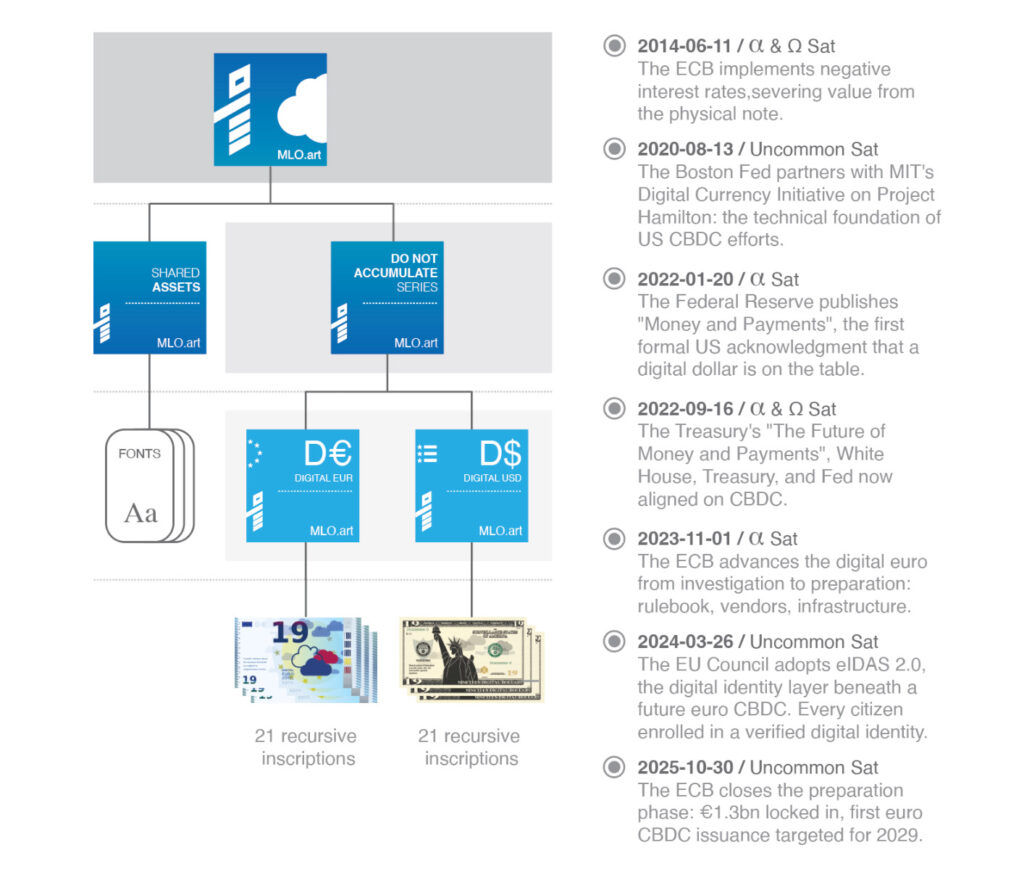
Editions 1 and 21 are inscribed on rare satoshis whose blocks were mined on real EU CBDC policy milestone dates: the day the ECB’s negative interest rates came into force (2014), the European Council’s adoption of eIDAS 2.0 (2024), and the closing of the ECB’s preparation phase (2025). The substrate carries the policy timeline alongside its imagined consequences. The title encodes the rule: D.N.A. spells Do Not Accumulate, and demurrage is its inner code, written into every note the way genetic code is written into every cell. In a nutshell, a permanent medium records a currency built to expire. The medium becomes the argument.
A note on 21. The recurring number is not incidental. Twenty-one editions per currency, twenty-one value states, twenty-one months in each cycle: each a small mirror of Bitcoin’s hard cap of twenty-one million coins. The constant that anchors an entire monetary system to code rather than to policy. The choice of substrate follows from the same logic. In a work about a currency that can be expired and restricted, surveilled and shaped from above, only an open, permissionless, censorship-resistant ledger can hold the critique honestly. The artwork lives on Bitcoin because Bitcoin cannot be edited, revoked, or programmed to forget.
Acknowledgement. With sincere thanks to Proper and Steven Reiss from Ancora for their guidance and patience in helping me inscribe, hunt, and split satoshis on my own. Working directly on Bitcoin, rather than through a service, was essential to the integrity of Do Not Accumulate: the same hands that make the artwork should be the ones placing it on the chain.