How the final Digital EUR edition of Do Not Accumulate became a Bitcoin transaction fee, and an open offer to the miner who now holds it.
Jump to: Series Introduction / Technical Breakdown / Lessons Learned / Offer for the Ocean miner
On July 21st, 2026, at 00:24 UTC, the Bitcoin network confirmed block 958,942. Buried in its fee pool was the final Digital EUR edition of Do Not Accumulate, my series about money that is designed to be spent. I had just spent it. Not sold it, not lost it to a thief, not burned it in any deliberate gesture: I paid it to a miner as part of a 758 sat transaction fee, by accident, while moving it between two of my own wallets.
This post is the record of how that happened, what I learned, and what I am offering the person who now holds it.
A currency designed to be spent
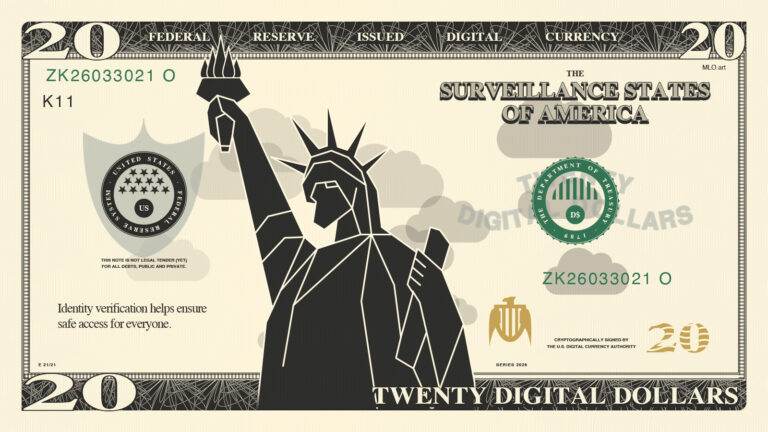
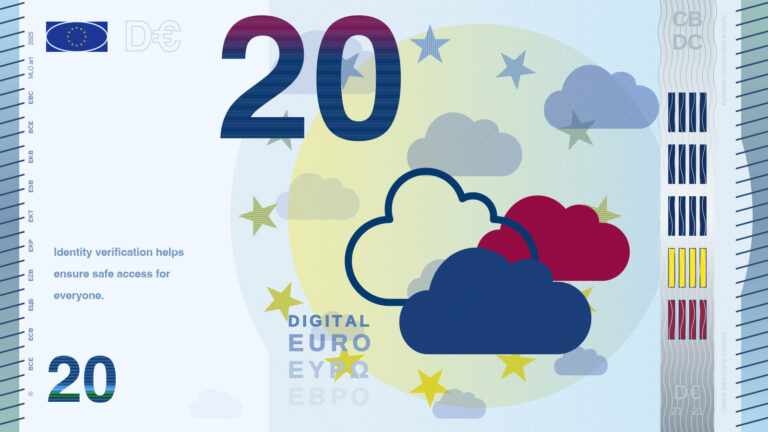
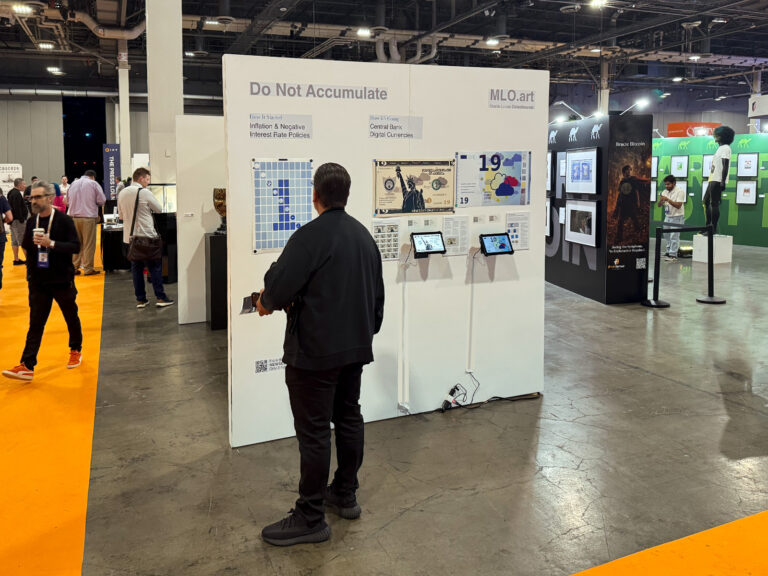
Do Not Accumulate is a series of programmable bills in two currencies, Digital EUR and Digital USD. The Digital EUR subseries counts 21 editions, HTML inscriptions on Bitcoin that behave like a demurrage currency, money programmed to lose value the longer it is held. The series is a critique of Central Bank Digital Currencies, and of the digital euro in particular: money whose issuer can decide not only what it is worth, but how, where, and for how long it may be held. Each edition performs that programmability as a 21-month decay cycle offset by one month from its siblings, so that at any moment the subseries displays every state of decay exactly once.
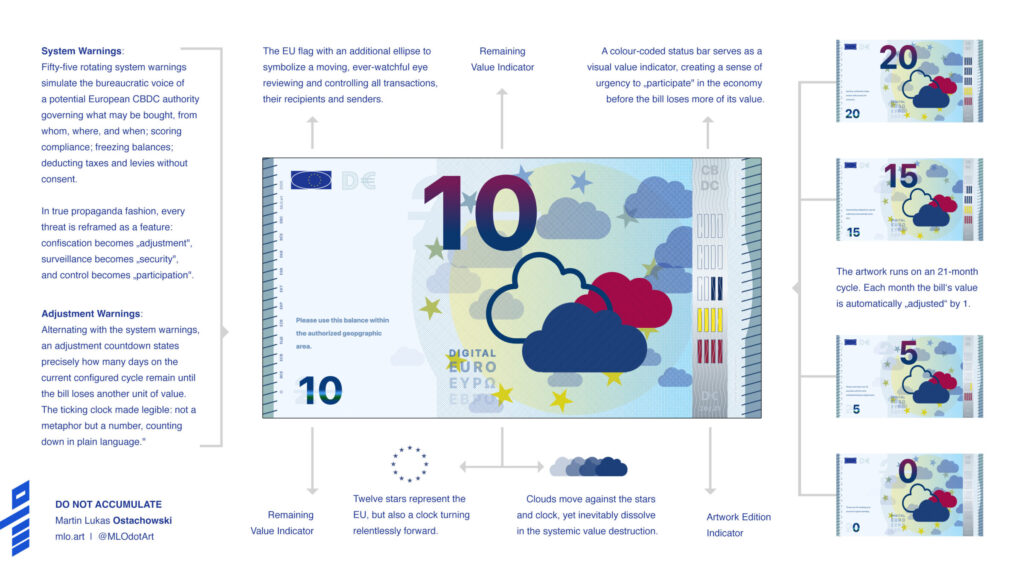
The cornerstone editions 1/21 and 21/21 also rest on uncommon sats, the first satoshi of a Bitcoin block chosen for its date. None of these sats arrived by chance; I hunted and purchased each one, so that the substrate of each subseries forms a conceptual timeline of its currency’s own history. Edition 21 rests on sat 1994200625000000, the first sat of block 921,442, mined on October 30th, 2025, the day the European Central Bank concluded the preparation phase of the digital euro and committed to building the currency. Where edition 1 opened the Digital EUR timeline on the identity rails of eIDAS 2.0, edition 21 closed it on the point of no return. Interestingly, it took that title more literally than I intended.
A transfer that looked successful
The mistake began as routine housekeeping. I set out to move the freshly inscribed editions 1 and 21 from one of my wallets to another, a transfer with no counterparty, no marketplace, and no deadline. I initiated it in Unisat, an inscription-aware wallet that builds such transfers correctly. The transaction felt slow, so I imported the wallet into Sparrow, an excellent desktop wallet for Bitcoin that is, however, completely blind to ordinals, and reached for its fee bump. The replacement confirmed, the receiving wallet showed 546 sats arriving in a fresh output, and I moved on.
Hours later, the inscription was nowhere to be seen. My first suspicion was theft. Stories of “sniped” inscriptions, stale listings executed at forgotten prices, and malicious transactions signed in haste circulate constantly in this space. However, the more I looked, the less the theory held. A transfer between two wallets that I control is supposed to be the safest operation in this ecosystem: there is no listing to exploit, no counterparty to deceive, no signature to phish. The threat did not come from outside. It came from the fee bump.
Replace-by-fee, the mechanism that lets a stuck transaction be reissued with a higher fee, has to fund that higher fee from somewhere. Sparrow, seeing only sats, rebuilt the transaction and reached for the coins my own wallet history had marked as expendable. Old annotations from an earlier rare sat purchase, “Omega Sat, Trash common sats”, still clung to those reused addresses, and Sparrow carried the labels forward onto every later receipt. At the moment of the bump, my own labels were telling me the bookend editions of Digital EUR were padding. The rebuild fed one of them to the fee: the 546 sat “postage” holding edition 21.
How a fee swallows a sat
Ordinal theory tracks individual satoshis through transactions with a first-in, first-out rule: the sats of all inputs form a single queue, the outputs claim that queue in order, and whatever remains at the tail is the fee, paid to the miner of the block.
The replacement transaction gathered three inputs from my wallet: 4,000 sats of plain funds, then 546 sats carrying Digital EUR 1/21, the opening edition of the subseries on its own uncommon sat, then, third in line, the 546 sats carrying edition 21. An inscription and its sat are one object; each edition travels wherever its sat travels. Its outputs claimed 546 sats for the destination wallet and 3,788 sats as change, 4,334 sats in total out of the 5,092 sats flowing in. Everything beyond position 4,334 in the queue, exactly 758 sats, became the fee.
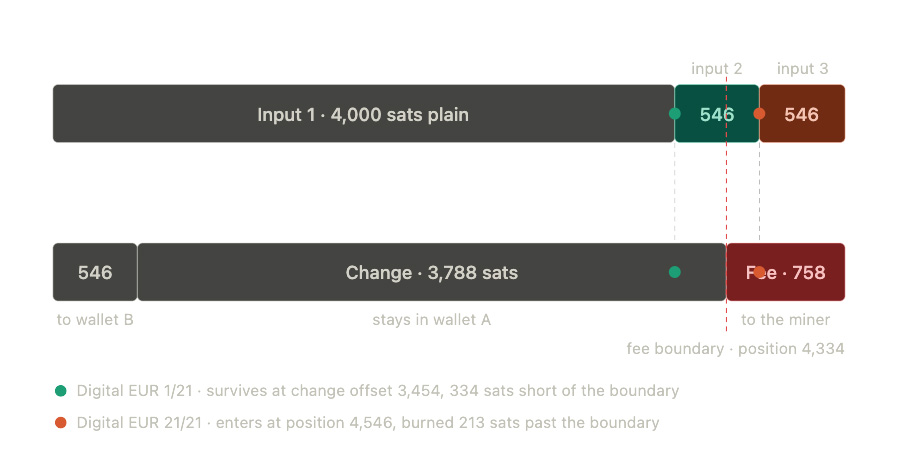
The inscribed sat entered the queue at position 4,546. It missed the last output by 213 sats.
The first 546 sats of the first input arrived at the destination on schedule, plain sats in an inscription-shaped output, which is why the transfer looked successful in the receiving wallet. Nevertheless, the actual bill had already left with the miner. Edition 1 survived at the very tail of my change. The opening and the closing bills of the subseries travelled in the same queue; the network took the last and missed the first by 334 sats. I went on to split Edition 1 properly in a new UTXO and it was sold the following day through Ord.net. Neither the buyer nor I knew at the time how close it had come.
In a nutshell: I pressed a button that every Bitcoin wallet offers, the wallet did exactly what it was designed to do, and the protocol did exactly what it was designed to do. The failure lived in the seam between two correct systems, a seam where ordinal theory assigns meaning that general-purpose wallets cannot see, and my own stale labels papered the seam over.
Hours later that same night, the surviving container made a similar journey, this time assembled by the same inscription-aware wallet the transfer had started in: edition 1’s UTXO first in the input order, plain funding behind it, and the fee carved exclusively from the plain tail. Same protocol, opposite outcome. The difference was never Bitcoin; it was whether the tool could see what it was spending.
Lessons, so you do not repeat them
- A wallet showing a successful transfer proves nothing about an inscription. Only the satpoint, the exact output and offset where the sat rests on an ordinals indexer, is evidence.
- Never let a general-purpose wallet manage keys that hold inscriptions or rare sats. If the seeds must coexist, freeze and label every ordinal-bearing UTXO the moment it arrives.
- Labels lie; the chain does not. Wallet annotations follow addresses and are inherited by every later receipt, so one reused address can dress an edition as spare change. Use fresh addresses for every inscription, and pin labels to the UTXO, not the address.
- Fee bumping is the sharpest edge. RBF and CPFP add inputs, and ordinals-blind coin selection will happily feed postage into the fee. Between wallets you control, patience is safer than speed.
- Keep rare sats in isolated, frozen, clearly labelled UTXOs, never inside spendable change.
- Before and after every move that matters: decode the transaction, check the input order, confirm the satpoint. The arithmetic takes minutes; the alternative is permanent. And read inscriptions on the rendered page, not a text copy; thumbnails do not survive copy-paste.
- Do not inscribe replacements. The original child of the parent collection remains verifiable forever; a duplicate would muddy the provenance more than the loss ever could.
Where the last Digital EUR bill rests now
The fee sats of block 958,942 flowed into its coinbase transaction, and here the story acquires its second author. The block was mined by OCEAN, the pool operated around Bitcoin Core developer Luke Dashjr and notably the most vocal opponent of inscriptions among mining organizations. OCEAN pays its miners directly inside the coinbase, so the roughly twenty outputs of that transaction are individual payouts. Edition 21 now sits at offset 30,850,938 of output 18, inside one miner’s payout of 0.3235 BTC. One person holds the final Digital EUR bill of Do Not Accumulate, and that person almost certainly has no idea.
The timing sharpens the constellation. OCEAN mined the first block signalling support for BIP-110 in March 2026 [2], and announced on July 13th that its backend will follow multiple chains independently in the event of a BIP-110 split [1]. BIP-110, formally the Reduced Data Temporary Softfork, is a contested proposal to impose one year of consensus-level limits on arbitrary data in Bitcoin transactions, capping most new outputs at 34 bytes and restricting several Taproot features that inscriptions rely on [3]. Whatever one feels about the proposal, the arrangement is remarkable: an artwork about money that must move was spent as pure fees and settled with a miner on the pool most committed to filtering artworks like it.
When I shared all of this with the group, Steven Reiss, an art historian and part of the Ancora team, refused to treat it as a loss story:
“Loss usually erases provenance, but here it produced some. On-chain, unfakeable, impossible to embellish.”
He pointed out that the iconoclast now holds the image, and that under the holder’s own worldview there is no artwork in that payout at all, only sats. I feel he is right. Most inscriptions carry no biography beyond minted, sold, transferred. This one now carries an event, written into the chain itself, verifiable by anyone, indefinitely.
Ancora deserves a broader thank you here. The team generously answered every question when I set out to inscribe the entire series myself, and together with the Ord.net team they traced this mishap with me, transaction by transaction, sat by sat.
An open offer
So this is not a recovery thread, and it is not a complaint. It is an offer with three doors, addressed to OCEAN and to one unknown miner.
Redemption:
If you hold the payout of output 18, I will pay a redemption fee of $1,000 for the return of the single inscribed sat. I paid to acquire this sat once, to place it in the series; I am prepared to pay a second time. I will prepare and cover a sat-controlled transaction that splits it cleanly from your payout, verified down to the individual satoshi, so that you keep everything that is yours. The last bill of a demurrage currency gets redeemed; it feels like the correct ending for both of us.
Refusal:
If you would rather decline on principle, sign a message saying so. A refusal of money over conviction, provable on-chain, becomes part of the work’s record, and I will honour it as such.
Silence:
If this never reaches you, the edition remains in your custody, tracked by the protocol, legible to anyone who looks. The chain keeps the record either way.
One protocol note, to keep the noise out: the only claim I can accept is a message signed with the key of the payout address. Reach me here or at @MLOdotArt on X/Twitter.
Under one reading, I lost an edition. Under another, the currency finally behaved exactly as designed: it refused to be accumulated, even by its maker. The scenario the series critiques, money made to move against its holder’s will, was executed on me by Bitcoin’s own fee market rather than by any central bank. Will the miner redeem the bill, refuse it, or never learn what the payout carries? I cannot answer that yet. For the first time since this series began, the money is fully out of my hands, and I am curious to find out.
Technical appendix
Inscription:
Digital EUR 21/21 – Do Not Accumulate
Inscription 4c60f6a22bc4da62eb50a8551fb3849594b9d498ec9f0460c88ec869eda63d77i0, revealed at height 957,504 on July 11th, 2026, resting on uncommon sat 1994200625000000 (first sat of block 921,442).
The fatal transaction:
5eddaf194401d28a614d966c3f36edfd8982159e2f88a5d5765be8df04aabdce confirmed in block 958,942 on July 21st, 2026, 00:24 UTC. Fee 758 sats (2.82 sat/vB). An RBF replacement of an earlier transfer, with the inscription UTXO added as the third input to fund the bump. That third input carried an anomalous relative timelock of 294 blocks (sequence 0x126), making the replacement unmineable before block 958,941 regardless of fee; it confirmed at 958,942, the first block it legally could.
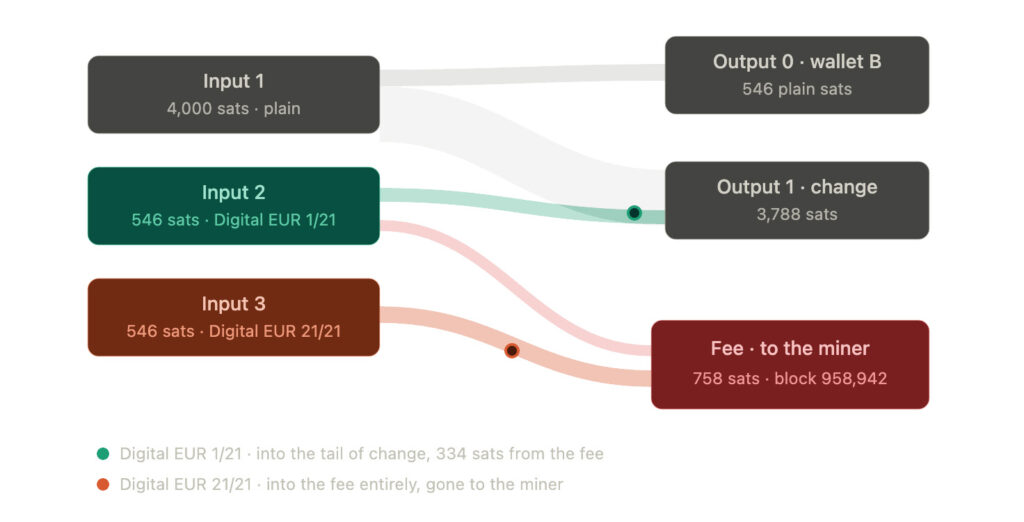
5eddaf194401d28a614d966c3f36edfd8982159e2f88a5d5765be8df04aabdceInputs (5,092 sats total, queue positions in brackets):
- 4,000 sats, plain funds [0 to 3,999]
- 546 sats, carrying Digital EUR 1/21 (inscription be9ef9830fae180ecec98b1de0ae2ba21df593672e9cd6d38efd3d607c0bee5ci0) on uncommon sat 1966491250000000 at offset 0 [4,000 to 4,545]
- 546 sats, carrying Digital EUR 21/21 (inscription 4c60f6a22bc4da62eb50a8551fb3849594b9d498ec9f0460c88ec869eda63d77i0) on rare sat 1994200625000000 at offset 0 [4,546 to 5,091]
Outputs (4,334 sats total):
- 546 sats to the destination wallet [claims 0 to 545]: plain sats, the “successful transfer”
- 3,788 sats change [claims 546 to 4,333]: the uncommon sat survives at offset 3,454, exactly 334 positions short of the fee boundary
Fee range:
Positions 4,334 to 5,091. The inscribed sat, at position 4,546, fell 213 sats past the boundary and was paid to the miner of block 958,942.
Current satpoint:
c894c0c9ce7d5e776f49619ae09dcf8281475e854bf5e737c19615bd9d283d35:18:30850938, output 18 of the block 958,942 coinbase, an OCEAN direct miner payout of 0.3235 BTC to 37dvwZZoT3D7RXpTCpN2yKzMmNs2i2Fd1n.
Itineraries, verified from raw transactions:
Edition 21 travelled from its reveal to 63bb3129...:0:0, into the fee of 5eddaf19..., and out through coinbase output 18 of block 958,942. Edition 1 travelled from its reveal to 63bb3129...:1:0, to 5eddaf19...:1:3454, onward intact to 7b50bc48...:0:3454, and through its sale to f352608c...:0:0.
All of the above is independently verifiable from the raw transaction and the ordinals index; no claim in this post requires trusting me.
Sources
- OCEAN Mining, announcement on multiple-chain support in the event of a BIP-110 split, X, July 13th, 2026: https://x.com/ocean_mining/status/2076763510596407616
- Bitget News, on OCEAN mining the first BIP-110 signalling block in March 2026: https://www.bitget.com/asia/news/detail/12560605480733
- KuCoin News, on the BIP-110 mandatory signalling window: https://www.kucoin.com/news/flash/bitcoin-bip-110-mandatory-signal-window-to-open-in-two-weeks-with-2-64-support
- The fatal transaction on mempool.space: https://mempool.space/tx/5eddaf194401d28a614d966c3f36edfd8982159e2f88a5d5765be8df04aabdce
- Inscription record on ordinals.com: https://ordinals.com/inscription/4c60f6a22bc4da62eb50a8551fb3849594b9d498ec9f0460c88ec869eda63d77i0
- The inscribed sat on ordinals.com: https://ordinals.com/sat/1994200625000000