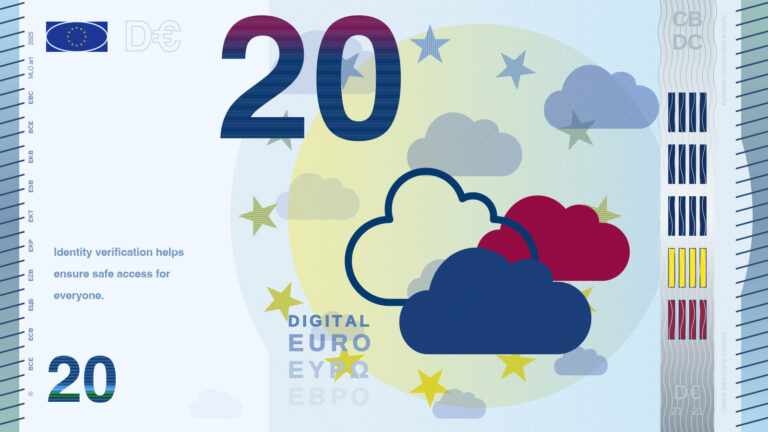
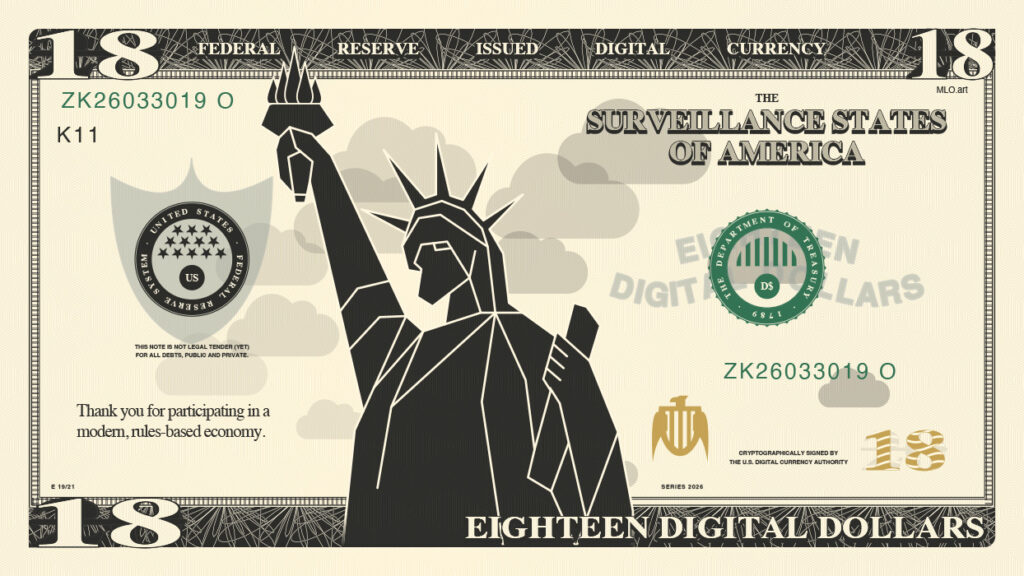
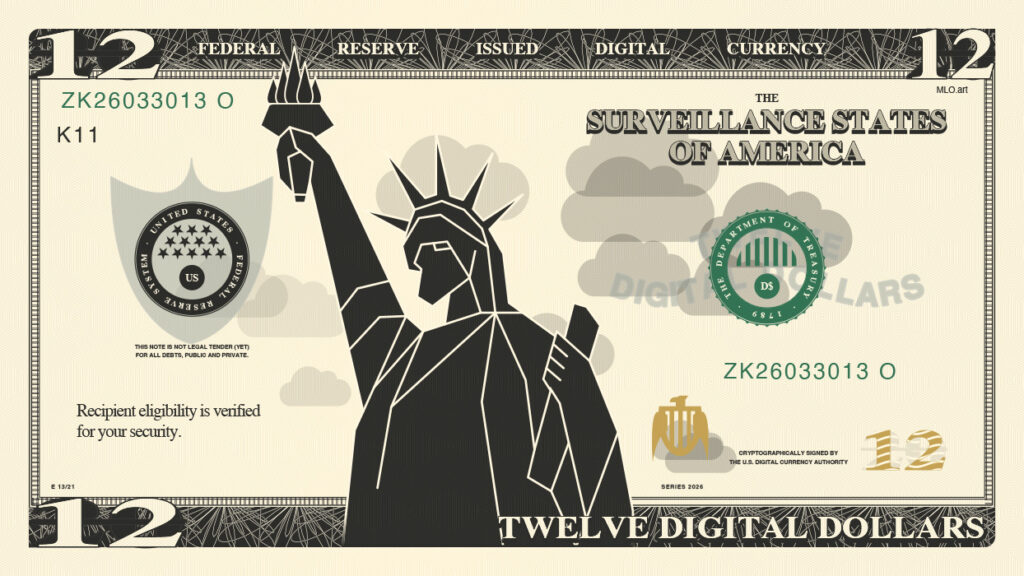
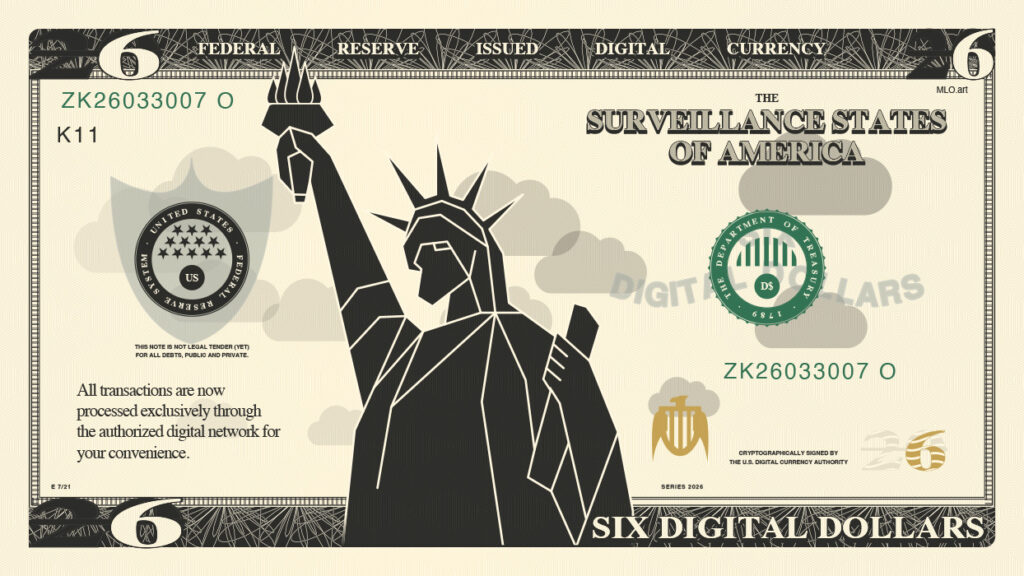
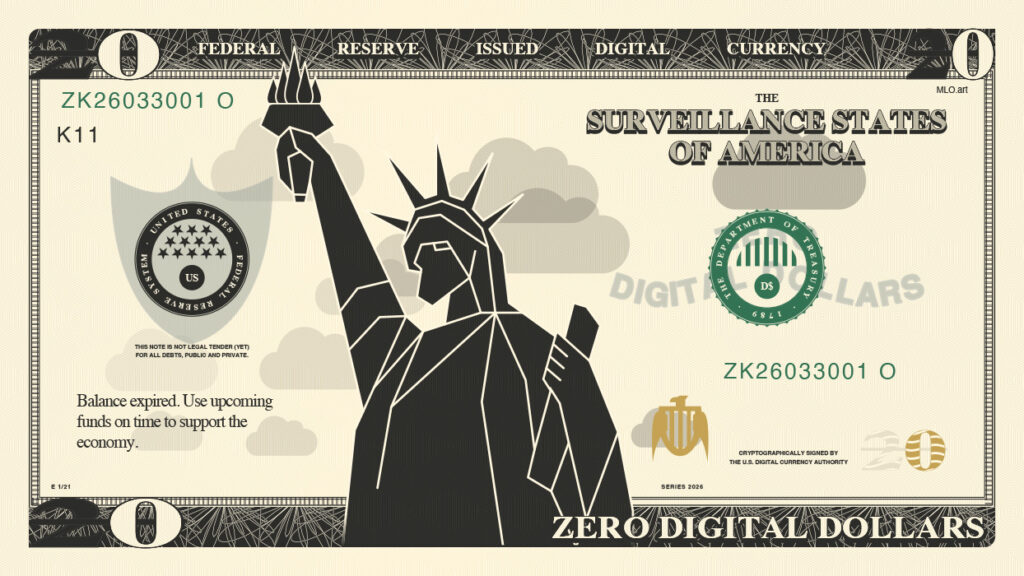
Part of Do Not Accumulate, a net.art series of imagined Central Bank Digital Currencies inscribed on Bitcoin. The Digital Dollar is a single, self-contained HTML banknote rebranded as a Federal Reserve-issued digital currency of the Surveillance States of America. Twenty-one editions exist, each programmed to lose value over a 21-month demurrage cycle.
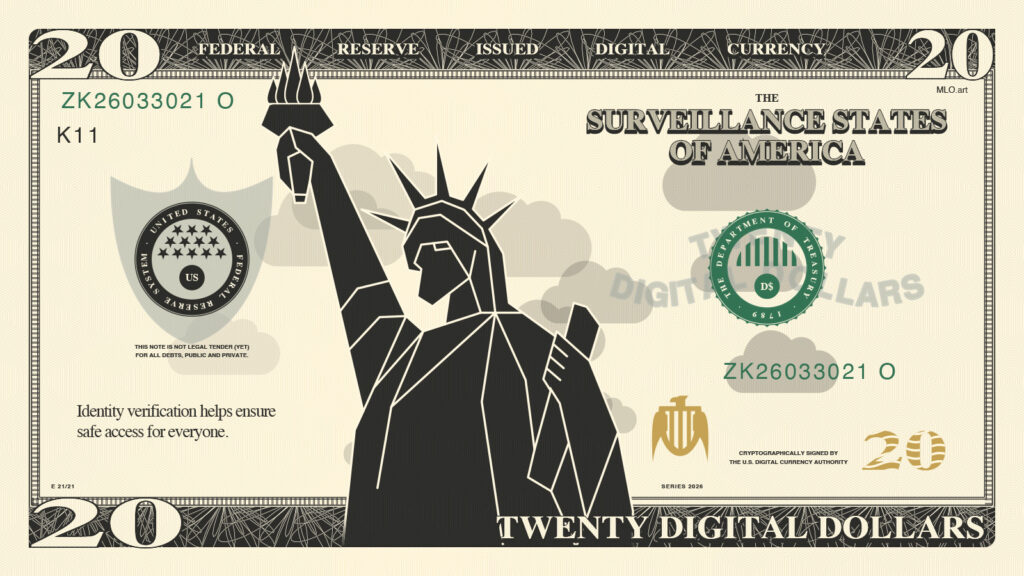
Visual references. Drawn entirely in vector graphics, the bill subverts the design language of the real US $20. The Statue of Liberty stands in the centre where Andrew Jackson once posed, and her torch reaches up to touch the FEDERAL RESERVE ISSUED DIGITAL CURRENCY header, setting it symbolically alight: the institution that made this moment possible, judged by the light of what it betrayed. Behind her back, clouds drift across the field, a threat from within the country reframed as weather. Below her, a small heraldic eagle no longer perches atop the striped shield of the real note but sits confined inside it, the freedom to transact bounded by the frame that once served as its stand.
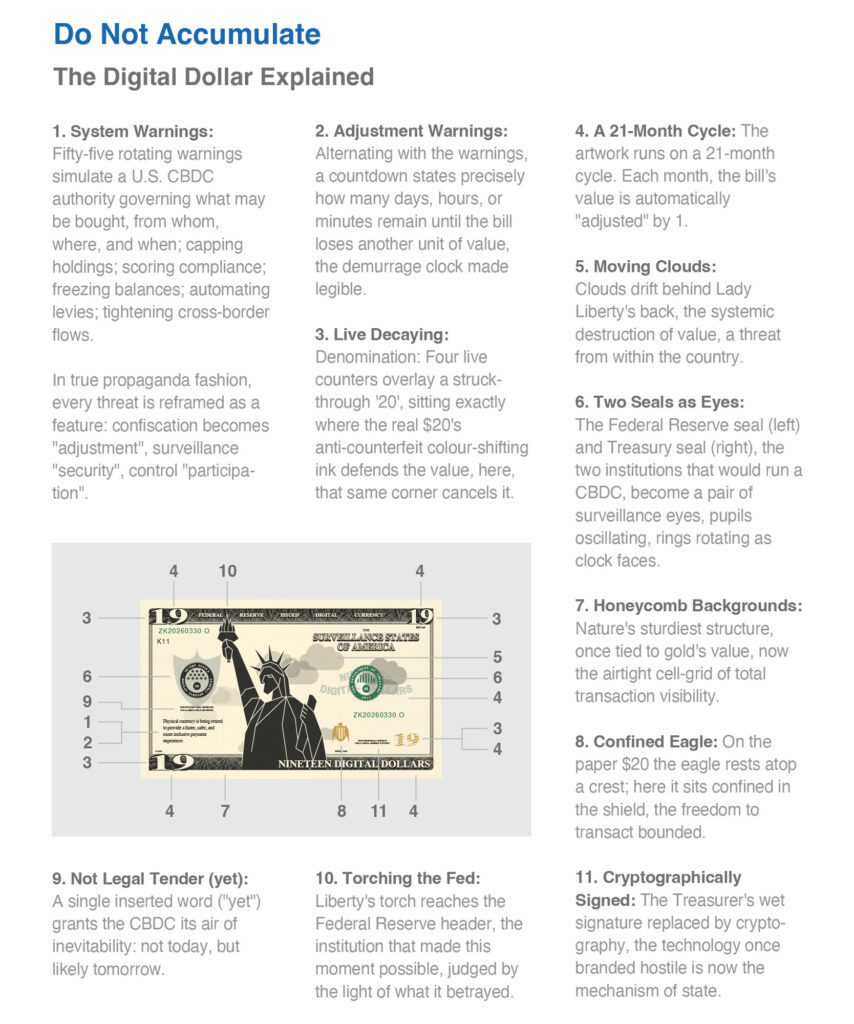
The Federal Reserve seal (left) and the U.S. Treasury seal (right), the two institutions that would operate a real U.S. CBDC, become a pair of surveillance eyes flanking Liberty, pupils oscillating and rings turning like clock faces. At the lower-left, four live counters overlay a struck-through “20”, sitting exactly where the real $20’s anti-counterfeit colour-shifting ink normally defends the denomination: here, the same corner cancels it. The honeycomb guilloché returns as a translucent ground: nature’s sturdiest structure, once tied to the gold standard, now the airtight cell-grid of total transaction visibility.
The masthead reads THE SURVEILLANCE STATES OF AMERICA. The footer wordmark descends with the value each month, from TWENTY DIGITAL DOLLARS down to zero. The fine print rewrites the historic legal-tender clause as NOT LEGAL TENDER (YET), a single inserted word granting the CBDC its air of inevitability, not today but tomorrow. In place of the Treasurer’s wet signature, a cryptographic mark reads Unconstitutionally Signed by the U.S. Digital Currency Authority: the technology once branded hostile is now the mechanism of state. The serial number returns as itself, slightly off.
The propaganda machine. As each edition advances through its cycle, the bill becomes its own propaganda machine. System warnings, adjustment notices, and demurrage countdowns appear on the note, selling the controls they impose. The recurring line, “Identity verification helps ensure safe access for everyone,” recasts mandatory KYC as care, just as the imagined dollar recasts surveillance, spending limits, and the erosion of privacy as features and conveniences.
Architecture. The work lives on Bitcoin as a recursive ordinal. A four-layer architecture (a shared artist layer, shared assets, the Digital Dollar currency layer, and twenty-one individual edition inscriptions) reconstitutes each note on demand, fully on-chain, with no external dependencies.
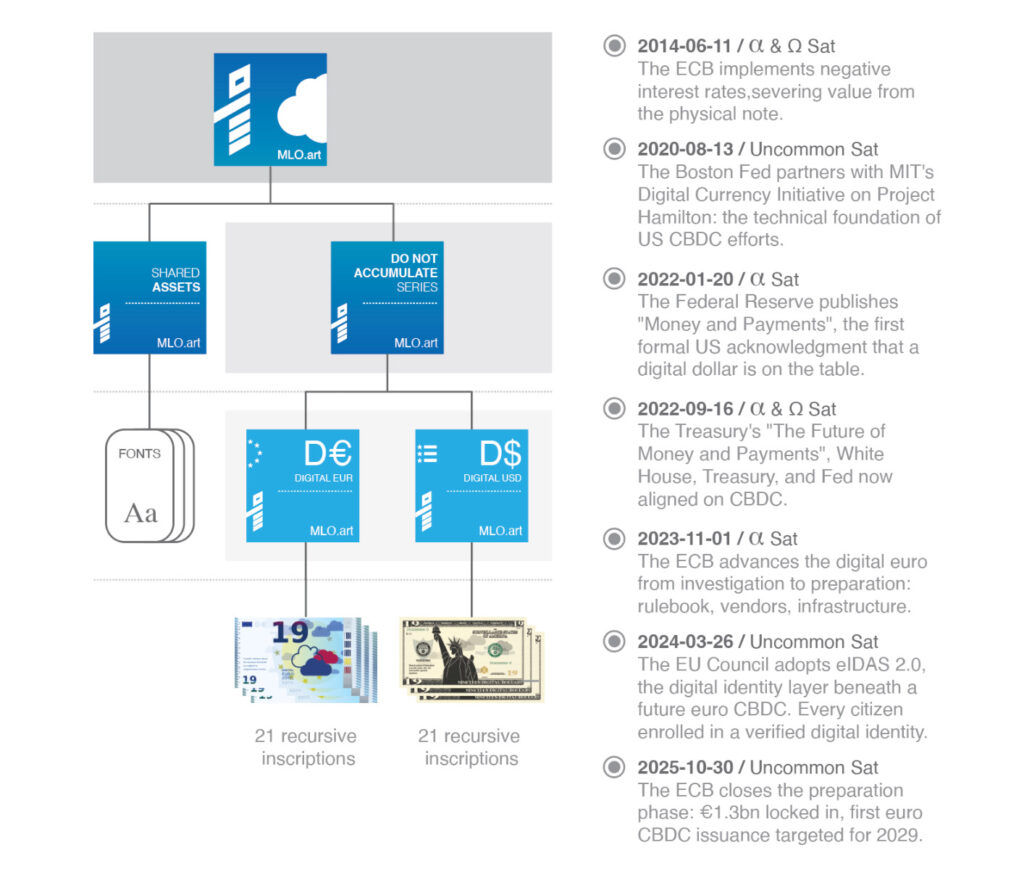
Cornerstone editions (1 and 21) are inscribed on rare satoshis whose blocks were mined on real US CBDC policy milestone dates: Project Hamilton (2020), the Federal Reserve’s Money and Payments paper (2022), and the White House Executive Order on Ensuring Responsible Development of Digital Assets (2022). The substrate carries the policy timeline alongside its imagined consequences. The title encodes the rule: D.N.A. spells Do Not Accumulate, and demurrage is its inner code. A permanent medium records a currency built to expire.